
Leading with Character: Managing Stress
Turbulence and change beget uncertainty, and uncertainty creates stress. We can’t control the causes of stress, so we must learn to cope with stress and focus instead on what we can control. That takes mental discipline, which I believe comes from day-to-day experience. In this blog I’ll share some practical experiences than helped me learn how to recognize and manage stress – in myself and others.
The Stress is in the Uncertainty
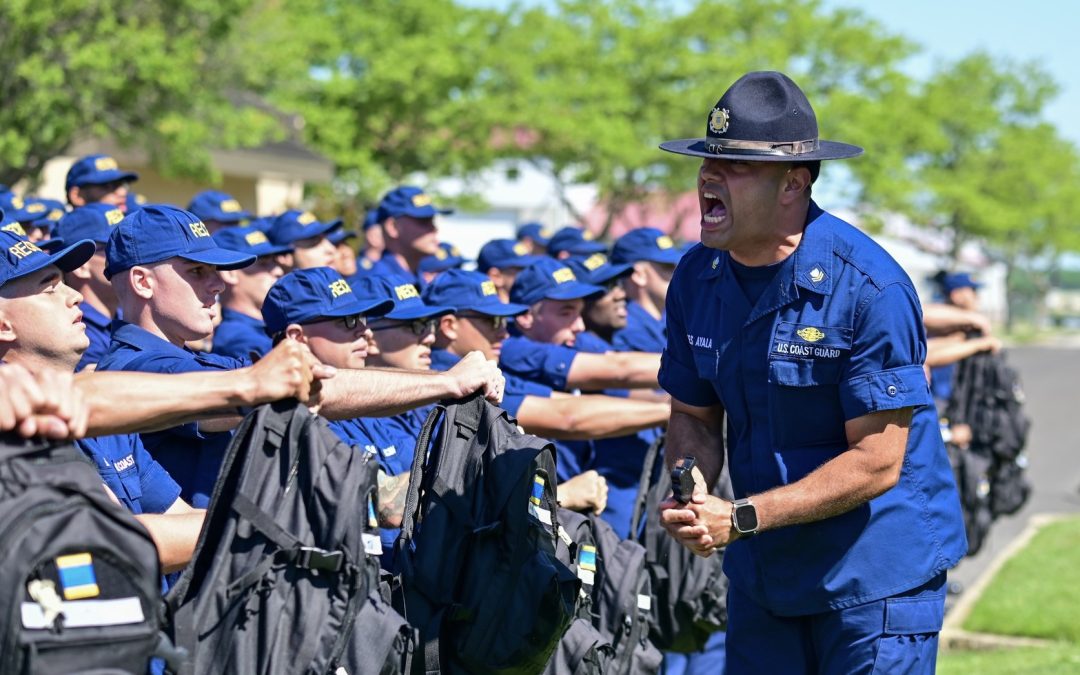
I learned a lot about the nature of stress while leading the US Coast Guard’s Recruit Training Center in Cape May, NJ (boot camp for prospective enlisted members) and later in my career leading the US Coast Guard Academy (college for prospective officers) in New London, CT. The enlisted and officer accession programs are really hard. They test students physically, mentally, emotionally, and spiritually.
Each element of the training curriculum poses its challenges, but the curriculum is designed so most students can succeed. During my time leading those Coast Guard accession programs, I observed that the stress is in the uncertainty—the uncertainty of what’s coming next—not in the difficulty of the curriculum. Trainers intentionally withhold the schedule to compel students to adapt and think on their feet. Students learn to be ready, individually and as a team, to face the challenges of each day despite not knowing in advance what those challenges might be. That builds resilience, which is vital to managing stress.
Coping with Uncertainty
This past week I had a prime opportunity to experience firsthand the stress caused by uncertainty. I was traveling home from a Modern Woodmen of America board meeting In Galena, IL late on a busy Friday afternoon. Even on a good day, it’s not easy to get from the small airport in Moline, IL to my home airport in Providence, RI. The trip started out surprisingly well, with an on-time departure to Atlanta, GA, where I was to connect with another flight up to Providence for a Friday night arrival. As luck would have it, an extensive system of powerful storms slammed the east coast and wreaked havoc with airline schedules.
To make a long story short, my connecting flight from Atlanta to Providence was cancelled at 2:00 am Saturday morning after hours in the terminal and on the tarmac. There were no flights available on that carrier for rebooking, so I found a flight on another carrier for later in the morning. I then had the pleasure of spending the rest of the night in the airport along with hordes of fellow detainees. In the morning, the trip once again started out well with an on-time departure to Washington, DC, where I was to connect with a flight continuing up to my destination in Providence. But we arrived in Washington DC to the news that the next leg to Providence was cancelled with no seats available until the next day, Sunday. By sheer luck, one seat opened up on a flight leaving later that day, and I eventually made it home Saturday night. What a relief!
The Power of Empathy
The ordeal was stressful for me, but I was fortunate to not have weekend obligations. Others were not so lucky. The airports were jammed full of displaced people crammed together with no idea how they’d get to their intended destinations. Some were crying—they were going to miss weekend graduations, weddings, and obligations of all kinds. I felt empathy for many of my fellow travelers. It wasn’t just me—that empathy seemed to sweep through the crowd as a counterbalance to the uncertainty of the schedule. Most people had been in one or more airports for 24 hours awaiting flights. It was sad to see the distress and hear the stories. Yet I observed a pleasantly unexpected effect of the stress…instead of being mean and cranky, people became kind and considerate.
Since the chairs were all full, many people sat in groups on the floor near the gates, boosting each other’s spirits. At one point the group next to my gate gave out a hearty cheer when their flight crew finally arrived (ours never did). People whose flights were not cancelled tried to give their seats to those who desperately needed to be somewhere. People waiting in chairs and at worktables put aside their devices and struck up conversations with their companions—something seldom seen in public places today. I joined in with one table as people got to know each other and good-naturedly tried to outdo each other’s stranding stories. We went our separate ways smiling and wishing our fellow travelers well.
The shared empathy and camaraderie I witnessed that weekend in the airport reminded me of the Coast Guard’s accession training programs. People from different walks of life find themselves in situations fraught with uncertainty—be it an airport, boot camp, or a workplace. Yet they come together as a group or a team to strengthen each other and overcome the stress. What a powerful testament to human nature.
Look in the mirror: What can you do as a leader to help cut through the uncertainty of turbulent times and encourage empathy to reduce stress?