
My husband, Bob, and I recently returned from three delightful weeks in the lakes and mountains region of southwestern Maine. One day we sallied forth on an excursion that led us through Grafton Notch in nearby New Hampshire. When the time came for a break, we pulled into the parking lot that served the trailhead for both the Appalachian Trail, and a difficult day hike we’d done a few times in prior years. Looking up and up and up at the imposing bluff that loomed high above, we were glad we’d decided earlier to not take on that steep ascent. The first time we hiked the “Eyebrow Trail,” it was so arduous I nicknamed it “Mount Misery.” It was nice to be enjoying the scenery from the comfort of our Subaru instead.
In the parking lot we met a man who had recently through-hiked the Appalachian Trail. On that day, he was waiting for friends to come down the mountain. He looked incredibly fit. We struck up a conversation and learned he had hiked the length of both the Pacific Crest Trail (2,650 miles) and the Appalachian Trail (2,198 miles). He’d also climbed most of the Colorado “Fourteeners,” which are the state’s 14,000+ peaks.
A Surprise Answer
I asked that endurance athlete, “Which trail was more difficult, the Pacific Crest Trail or the Appalachian Trail?” And here’s where I’ll pause and ask you readers, what do you think…the Pacific Crest Trail or the Appalachian Trail? Go ahead, give it a guess.
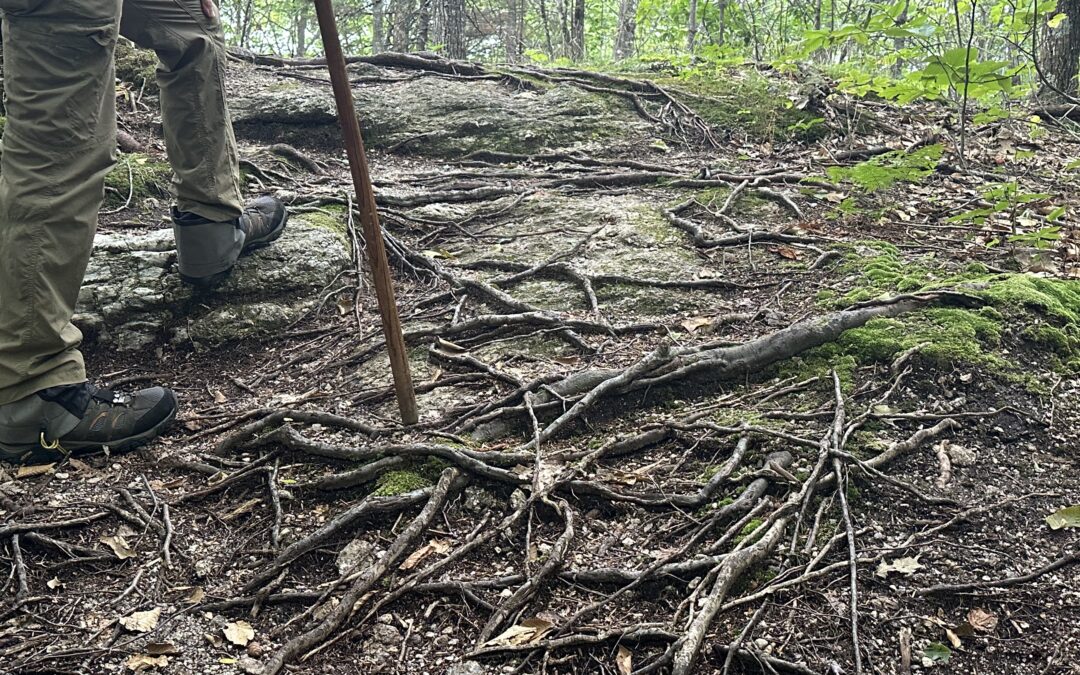
I have hiked very small sections of each trail and expected our hiker to tell us the Pacific Crest Trail was the harder one. But no. He replied without hesitation, “The Appalachian Trail.” Knowing that the Pacific Crest Trail is longer and at higher elevation, with snow and other hazards, I presumed it would have been by far the more difficult. So, I asked the hiker why the Appalachian Trail was harder. He replied simply, “Roots and stones.”
The Little Things
Roots and stones. The little things you’d likely not think of. Unless you’ve hiked the Appalachian Trail. As soon as our hiker made that assertion I thought, you know, he’s right. The Appalachian Trail has many sections that are straight up and straight down. When erosion washes away the soil, those trails become nothing but roots and stones. They’re trip hazards and obstacles that make every step a calculated risk, especially on the descent when a misstep can cause serious injury.
So how does this roots and stones analogy apply to the workplace? Striking out on a mission (as we did in the US Coast Guard), tackling a project with a deadline, or striving to achieve goals and objectives, leaders and their teams often look out for the big, obvious challenges. Well prepared leaders will anticipate those challenges and be ready to work through and overcome them…perhaps even innovate to turn them in to opportunities. But in my experience, it’s the little things, like the roots and stones underfoot on a trail, that have been my nemesis.
That’s because if I keep my eyes continually on the trail to avoid tripping, I’ll miss what’s going on around me. I won’t see the beautiful red fox darting across the trail up ahead, or notice the ancient oak tree rooted stoically into the mountainside. I might even miss the trail marker and get lost. So, I’ve learned to stop along the trail, even if I’m not particularly tired, to get my bearings and be sure I’m not missing all the things I came into the woods to experience. Or miss the turn in the trail and lose my way. I’ve applied that lesson on the trail to becoming a better leader in the workplace by trying to avoid the trip hazards while maintaining situational awareness.
A Disaster Averted
Here’s a quick example of the importance of paying attention to the roots and stones. I was commanding a 210-foot ship deployed in the North Atlantic Ocean during a storm. We had been called to get underway to save a sailboat, disabled and adrift, hundreds of miles off the East Coast. We checked the big things when we got underway—the fuel status, provisions, pending weather, etc. We performed the required drills to be sure every crewmember knew his or her place and duties should an emergency arise. We completed our underway checklist and conducted our pre-deployment briefing.
Once underway, we made the best possible speed given the storm conditions. The ship was rolling, but heck, it’s designed for that. I was doing my best to keep the big picture while the crew performed their duties. Suddenly, the ship rolled a little harder, and up on the bridge we got a call from the engine room requesting we sound the general emergency alarm and send the crew to their stations.
As it turns out, a huge toolbox that had been mounted in the engine room had broken free from its brackets and was hurled across the space. During its unintended flight, the toolbox struck a valve on one of the main diesel engines and fuel started to spray out. That could have caused an engine room fire. But thankfully, a junior fireman, one of the lowest-ranking members of the crew, jumped into action and shut down the engine before it could catch on fire, saving the ship from what could have been a disaster. That improperly secured toolbox was a small thing—like roots and stones on the trail—that nearly caused a casualty that day.
Look in the mirror: What can you do to improve your situational awareness and become a more observant, engaged leader who sees the big picture, but who is also careful to avoid tripping on the roots and stones?
Please join me again next time for more on Leading with Character.
If you enjoyed this post, please visit my website where you can buy my book, Breaking Ice & Breaking Glass: Leading in Uncharted Waters, and sign up for my mailing list: https://sandrastosz.com/book/breaking-ice-and-breaking-glass/